
NASA Artemis II Moon Mission Launch Inspires Future Exploration – Intermediate – EN
NASA launched its Artemis II mission from Florida on Wednesday evening, sending four astronauts toward the moon and exciting huge crowds along the Space Coast. The towering orange-and-white rocket rose at 6:35 p.m. Eastern and headed over the Atlantic Ocean. Spectators packed nearby beaches, hugged, and cheered as a bright column of fire and a long white trail crossed the clear sky.
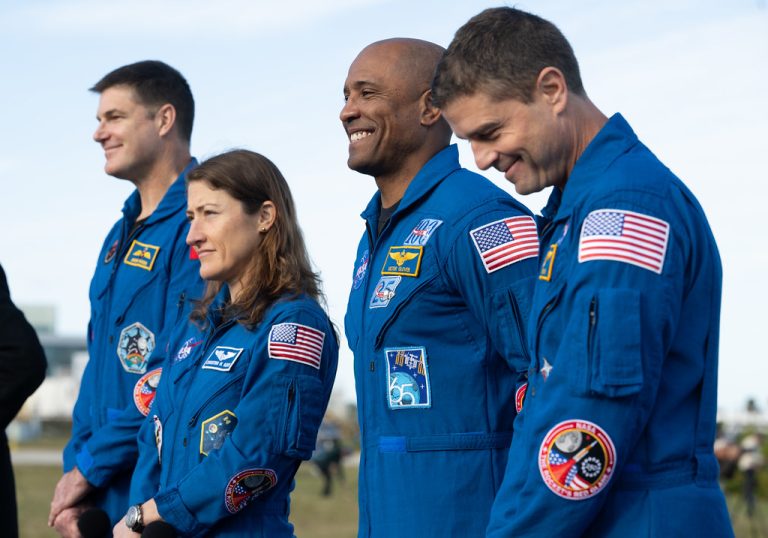
The crew — Reid Wiseman, Victor Glover, Christina Koch, and Jeremy Hansen — is traveling aboard the spacecraft Integrity. Their trip will cover more than 695,000 miles. They will fly around the moon and return to Earth without landing, testing whether the spacecraft can safely carry humans on future lunar missions. NASA says the mission is a major step toward new moon landings and a lasting human presence there.
Artemis II also includes several historic firsts. Glover will become the first Black man to travel into deep space, Koch the first woman, and Hansen the first non-American to join a moon mission of this kind. The last time astronauts traveled this far was Apollo 17 in 1972.
Engineers solved several technical problems during the countdown, including issues involving the rocket safety system and a sensor in the crew escape system. After liftoff, controllers briefly lost the ability to hear the astronauts, and the crew also reported a toilet problem. Even so, NASA called the launch a success. If the rest of the mission goes well, Artemis II will help open the way for astronauts to return to the moon by the end of the decade.
Vocabulary Words List
towering — extremely tall
launched — sent into space
astronaut — a person trained to travel in space
spectators — people watching an event
packed — filled tightly with people
column — a tall rising shape
trail — a line left behind
spacecraft — a vehicle designed for space travel
trip — a journey from one place to another
cover — to travel across a distance
safely — without danger
lunar — related to the moon
presence — continued being in a place
historic — important in history
deep space — space far beyond Earth
countdown — the final timed steps before launch
engineers — people who design or fix machines
issues — problems
sensor — a device that detects information
escape system — equipment that helps a crew get away from danger
controllers — people guiding a mission from the ground
reported — gave information about
success — a good result
decade — a period of ten years
crew — the people working together on a spacecraft
mission — an organized journey with a goal
surface — the outside part of something
return — to come back
orbit — the curved path around a planet or moon
exploration — travel to learn about new places
Fill In The Blanks Listening Practice
NASA its Artemis II from Florida on Wednesday evening, sending four astronauts toward the moon and exciting huge crowds along the Space Coast. The orange-and-white rocket rose at 6:35 p.m. Eastern and headed over the Atlantic Ocean. nearby beaches, hugged, and cheered as a bright of fire and a long white crossed the clear sky. The — Reid Wiseman, Victor Glover, Christina Koch, and Jeremy Hansen — is traveling aboard the Integrity. Their will more than 695,000 miles. They will fly around the moon and to Earth without landing, testing whether the spacecraft can carry humans on future missions. NASA says the mission is a major step toward new moon landings and a lasting human there. Artemis II also includes several firsts. Glover will become the first Black man to travel into , Koch the first woman, and Hansen the first non-American to join a moon mission of this kind. The last time astronauts traveled this far was Apollo 17 in 1972. solved several technical problems during the , including involving the rocket safety system and a in the crew . After liftoff, briefly lost the ability to hear the astronauts, and the crew also a toilet problem. Even so, NASA called the launch a . If the rest of the mission goes well, Artemis II will help open the way for astronauts to return to the moon by the end of the .
Vocabulary Retention Quiz
1. What was the main goal of Artemis II?
2. How far is the round trip expected to be?
3. Who will become the first woman to travel into deep space on this mission?
4. What technical issue happened after liftoff?
5. Why is Artemis II important for future moon plans?
Discussion Questions
Why do you think big space missions still matter today?
How can a mission without a moon landing still be important?
Do historic “firsts” on a mission change how people see space exploration?
Try this article in other languages and difficulties:
English (Beginner), Spanish (Beginner), Spanish (Intermediate), French (Beginner), French (Intermediate), Italian (Beginner), Italian (Intermediate), German (Beginner), German (Intermediate)